


Broadcom's latest salvo targets not the GPU but the network fabric that connects thousands of them.
Broadcom's latest salvo targets not the GPU but the network fabric that connects thousands of them.
Broadcom's latest salvo targets not the GPU but the network fabric that connects thousands of them.
Broadcom is challenging Nvidia in AI data center networking, a market where Ethernet switch sales more than doubled in the first quarter as GPU clusters strain traditional fabric designs.
"Ethernet is gaining ground as buyers look for standards-based systems and broader vendor options," Dell'Oro Group said in a June 2 report, noting that Ethernet accounted for about two-thirds of AI cluster switch sales in the first quarter of 2026.
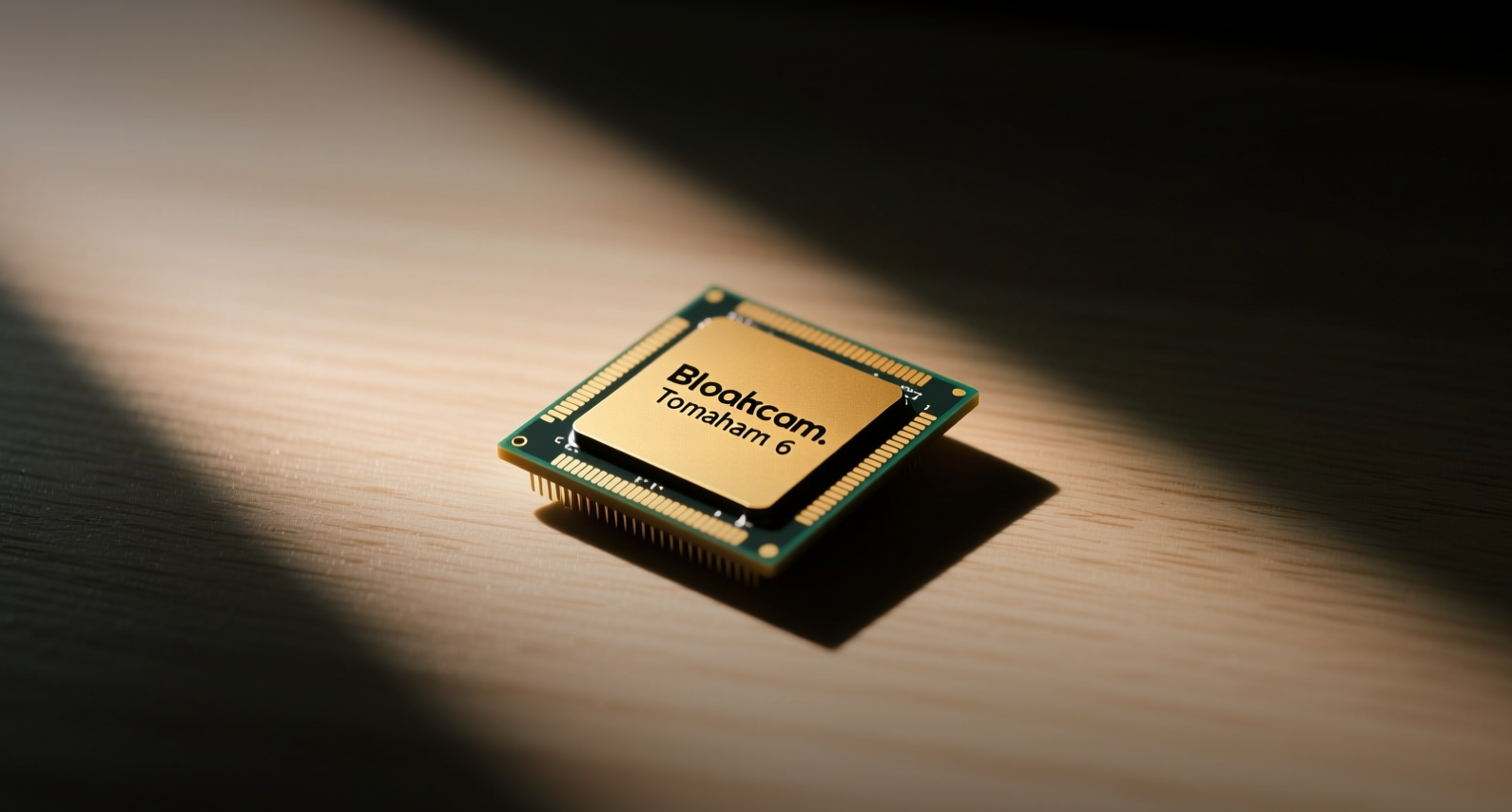
Broadcom's Tomahawk 6 switch chip delivers 102.4 Tbps of switching capacity and is designed to support clusters exceeding 1 million accelerators, the company said in June 2025. Nvidia's Spectrum-X platform helped it become the top data center Ethernet switch vendor by revenue in the first quarter, according to IDC data reported by Business Insider. The two companies are racing to supply the fabric layer as AI training traffic — dominated by all-reduce and all-to-all operations — creates congestion that can leave expensive GPUs idle.
The networking bottleneck threatens to become the next constraint on AI infrastructure after power and cooling. Broadcom's push into Ethernet fabric gives hyperscalers an alternative to Nvidia's integrated GPU-to-network stack, potentially shifting procurement decisions. The Ultra Ethernet Consortium released Specification 1.0 in June 2025, aiming to make multi-vendor integration easier, though interoperability at scale remains unproven.
Why the Fabric Layer Matters for AI Economics
AI training clusters depend on GPUs exchanging data through all-reduce and all-to-all operations. When the network congests, accelerators wait instead of compute. Researchers at a high-performance computing lab found that congestion has become a major limitation for systems supporting scalable AI training, especially as cluster sizes grow and traffic becomes more bursty.
Broadcom's networking push targets this pain point. The company's Tomahawk 6, built on a 3nm-class process, competes directly with Nvidia's Spectrum-X and InfiniBand offerings. While InfiniBand remains important for large training environments, Ethernet is gaining share as buyers seek to avoid vendor lock-in and integrate with existing operations. Dell'Oro Group said 800 Gbps switches made up the vast majority of AI back-end Ethernet shipments in the first quarter, while 1.6 Tbps switches had begun sampling and were expected to ramp later in 2026.
The shift is visible in procurement patterns. AI data center operators are asking whether fabric designs can handle expected all-reduce and all-to-all traffic, which components are tied to a single vendor, and whether the supplier has documented deployments at the planned cluster size. These questions now carry equal weight to GPU availability and power density in infrastructure planning.
What This Means for AVGO and NVDA
For Broadcom, success in AI networking could open a new revenue stream beyond its existing custom chip partnerships with companies like Meta and Google. The company already designs custom AI processors for hyperscalers, and adding networking silicon to that portfolio strengthens its position as a full-stack infrastructure supplier.
For Nvidia, the challenge comes at a time when its data center business faces increasing competition from custom silicon and rival networking solutions. Nvidia's advantage has been its integrated stack — GPU, networking, and software working together. If Broadcom can offer a competitive fabric that integrates with multiple GPU vendors, that advantage narrows.
Nvidia shares trade at about 35 times forward earnings, reflecting the market's expectation that its AI dominance will persist. Broadcom trades at a lower multiple, partly because its AI revenue is less visible and spread across multiple product lines. If Broadcom's networking bet gains traction, that valuation gap could narrow as investors reprice the company's AI exposure.
This article is for informational purposes only and does not constitute investment advice.
