


Alphabet's plan to spend as much as $205 billion on artificial intelligence infrastructure this year is funneling capital directly to two key supply chain partners: Broadcom and Cipher Digital.
Alphabet's plan to spend as much as $205 billion on artificial intelligence infrastructure this year is funneling capital directly to two key supply chain partners: Broadcom and Cipher Digital.
Alphabet's plan to spend as much as $205 billion on artificial intelligence infrastructure this year is funneling capital directly to two key supply chain partners: Broadcom and Cipher Digital.
Alphabet on July 22 reported second-quarter revenue of $119.8 billion, up 24 percent from a year earlier, and raised its full-year 2026 capital expenditure forecast to a range of $195 billion to $205 billion — up from $180 billion to $190 billion previously. The midpoint of $200 billion represents roughly 42 percent of Alphabet's annualized revenue run rate, a ratio more typical of capital-intensive utilities than a software-driven advertising business. Chief Financial Officer Anat Ashkenazi told analysts the increase was "primarily due to an acceleration in the delivery of capacity to meet growing demand."
"The scale of hyperscaler capex is creating a structural tailwind for the entire AI supply chain, from custom silicon to data center shells," said Stacy Rasgon, senior analyst at Bernstein. "Broadcom's TPU business with Google is a direct beneficiary, and Cipher Digital's model of providing pre-built data center capacity solves a real bottleneck for hyperscalers racing to deploy."
Google Cloud revenue surged 82 percent to $24.8 billion, far exceeding the $22.5 billion consensus, and its contracted backlog swelled to $514 billion — suggesting the spending is backed by real customer commitments rather than speculative buildout. Alphabet's second-quarter capital expenditure reached a record $44.9 billion, more than double the year-ago figure, with roughly 60 percent directed at servers and AI accelerators and the remainder funding data center construction and networking. Management added that 2027 spending would increase "significantly" beyond 2026 levels.
Broadcom's TPU franchise gets a boost
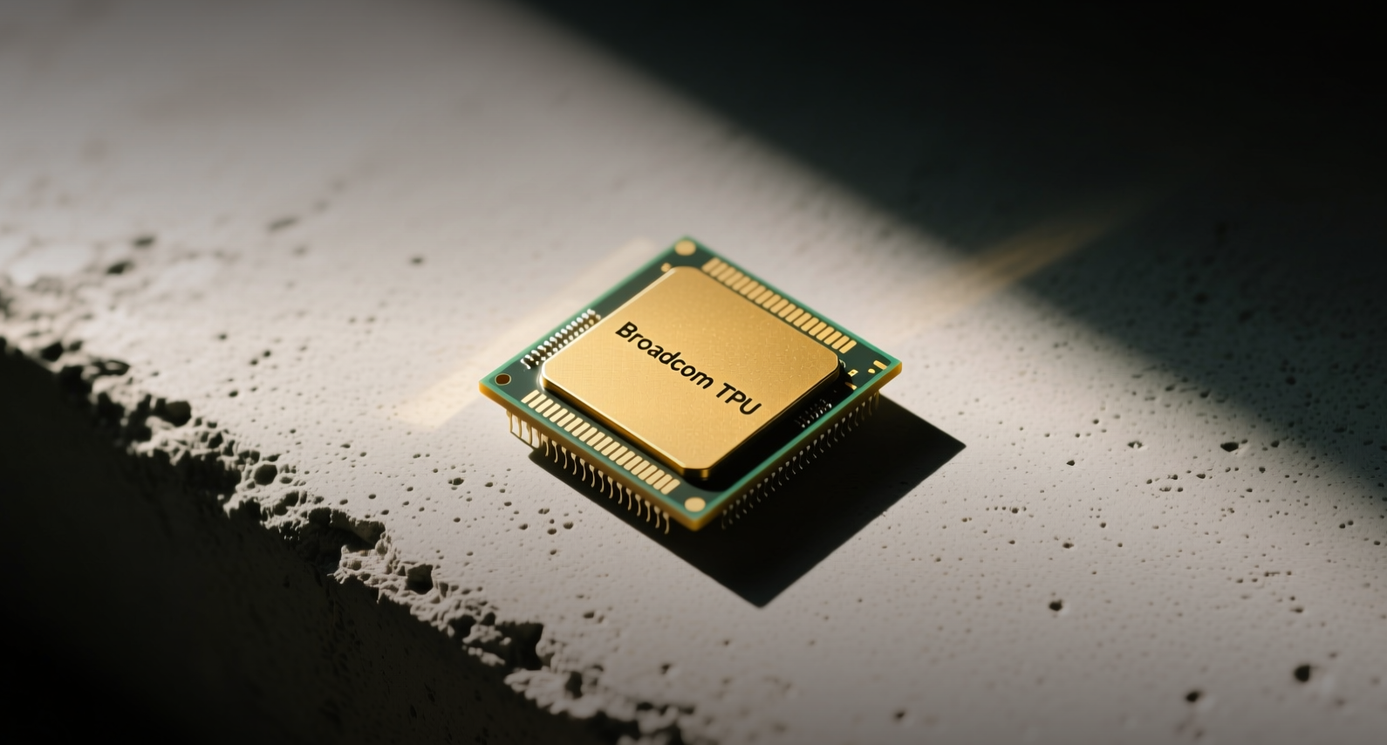
Broadcom designs Alphabet's tensor processing units, or TPUs — custom AI chips that Google uses to train and run its Gemini models. The TPU franchise has become a meaningful revenue driver for Broadcom, which reported $28.1 billion in semiconductor revenue in its fiscal 2025. Each new generation of TPU requires more compute density and memory bandwidth, pushing up the bill of materials per chip. Alphabet's commitment to spending $200 billion-plus annually means Broadcom's design win with Google is likely to generate sustained royalty and services revenue for years, even as Alphabet diversifies its chip supply with Nvidia GPUs.
The relationship also insulates Broadcom from the pricing pressure that commodity chip suppliers face. Custom ASIC contracts typically lock in margins for the duration of a product generation, and Alphabet's accelerating buildout suggests multiple TPU generations are already in the pipeline. Broadcom shares have fallen 18 percent this year amid the broader tech selloff, but the Alphabet capex trajectory provides a floor for the company's AI-related revenue outlook.
Cipher Digital fills the infrastructure gap
Cipher Digital operates a different model. Rather than designing chips, it builds and operates data center campuses that hyperscalers lease on a wholesale basis. The company's value proposition is access to power and land — the two hardest-to-source inputs for AI data center construction. With Alphabet, Amazon, Microsoft, and Meta projected to spend a combined $725 billion on capital expenditures in 2026, up roughly 77 percent from $410 billion in 2025, the demand for pre-built data center capacity has outstripped supply.
Cipher Digital's facilities give hyperscalers the flexibility to deploy their own custom chips — including Google's TPUs — without the multi-year lead time required to build from scratch. The company has secured long-term leases with several hyperscalers, providing recurring revenue visibility that supports its own capital-raising efforts. For investors, Cipher Digital offers a way to bet on AI infrastructure without taking direct commodity exposure to memory or GPU pricing cycles.
The investment angle
Alphabet shares fell 7 percent on the capex news as investors focused on the negative free cash flow — negative $5.9 billion in the second quarter, the first such reading in the company's history. But for supply chain partners, the spending represents a multi-year revenue commitment. Broadcom trades at roughly 22 times forward earnings, a discount to its five-year average of 28 times, suggesting the market has not fully priced in the TPU revenue stream. Cipher Digital, as a smaller and less liquid name, carries higher execution risk but also greater upside if the AI buildout continues at its current pace.
The key risk is a synchronized pullback in hyperscaler spending. If any of the four largest cloud builders — Alphabet, Amazon, Microsoft, or Meta — signals a capex slowdown, the entire supply chain would reprice. For now, the data points in the other direction: Alphabet's $514 billion cloud backlog and 82 percent Cloud revenue growth suggest demand remains supply-constrained, not demand-constrained.
This article is for informational purposes only and does not constitute investment advice.
