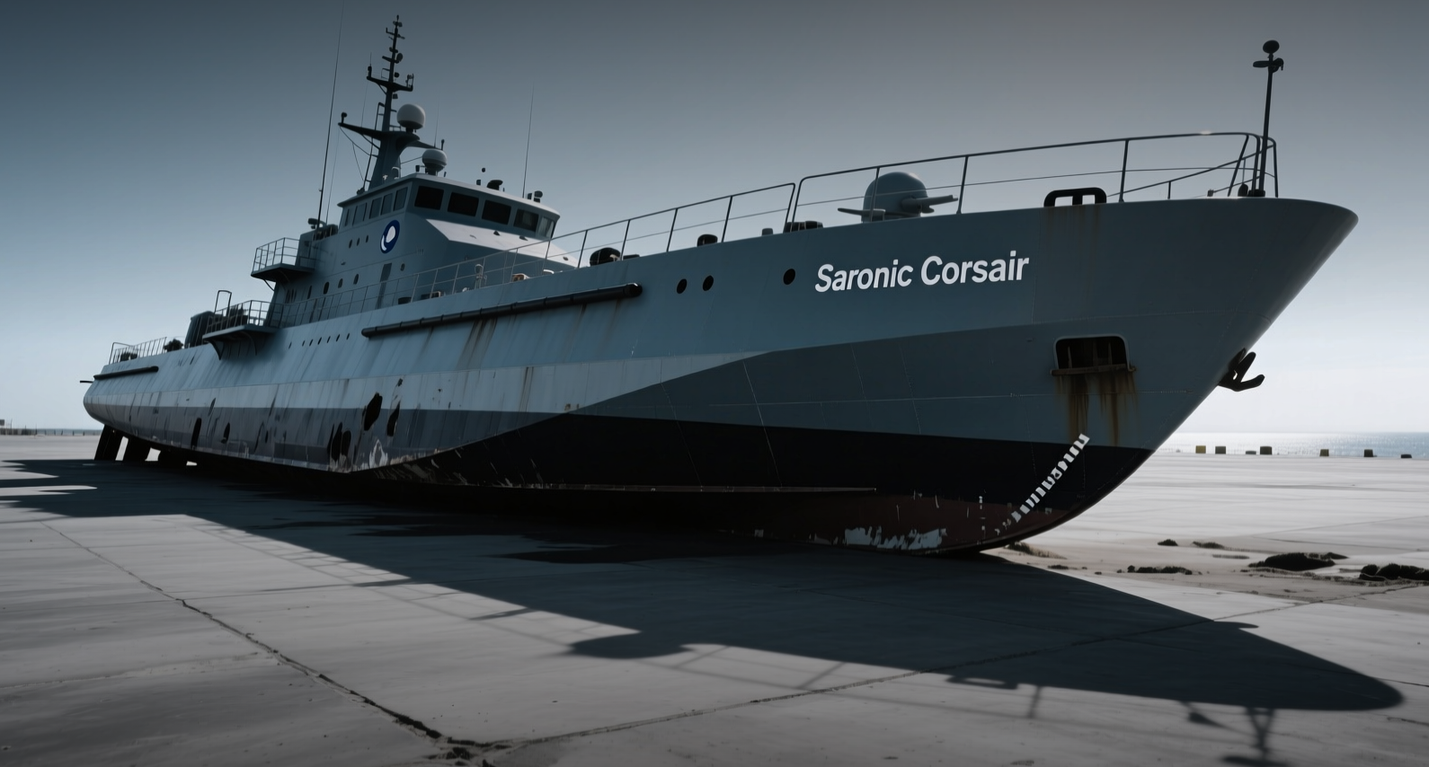
Three American drone boats attacked an Iranian submarine and ship maintenance facility Sunday, marking the first combat use of sea drones by US forces and signaling a new phase in the escalating conflict over the Strait of Hormuz.
The US Central Command said three Saronic Corsair unmanned surface vessels struck the Bandar Abbas Naval Base in a kamikaze mission, hitting a submarine and ship maintenance facility. The attack was part of a broader wave of strikes that hit more than 300 targets across southern Iran over the weekend, including on Qeshm Island, after President Donald Trump said another ceasefire had broken down.
"The strikes degraded Iran's ability to continue attacking commercial shipping," Central Command said in a statement Monday, releasing video footage that showed the 24-foot drone boats racing toward the port before detonating.
The Corsair vessels, built by Austin-based Saronic Technologies, carry payloads of as much as 1,000 pounds and can travel more than 1,150 nautical miles at speeds up to 35 knots. Each boat costs less than $1 million, according to the company. The drones arrived in the Middle East in late March as part of the Navy's Task Force 59, an artificial intelligence and drone unit established by Central Command chief Adm. Brad Cooper in 2021. Last month, a Corsair rescued the crew of a US Army AH-64 Apache helicopter that was downed off the coast of Oman — an incident the US blamed on Iran.
Sea Drone Warfare Goes Mainstream
The deployment marks a milestone for the Pentagon's push to integrate unmanned systems into combat operations, a strategy accelerated by lessons from the war in Ukraine. Kyiv has used maritime drones since at least 2022, when it struck a Russian naval base, and has since deployed them to hit warships, oil tankers and a bridge connecting Russia to occupied Crimea. Ukraine's security service said last year it had disabled a Russian submarine with an underwater drone — a reputed first in naval warfare.
The US has been experimenting with sea drones for years, using them for surveillance, mine clearance and simulated attack swarms. But Sunday's strike was the first time American forces used them in live combat. In February, the military deployed Low-Cost Unmanned Combat Attack Systems, or LUCAS drones — modeled after Iran's Shahed drones — against Iranian targets during Operation Epic Fury, marking another first for one-way attack drones.
Saronic, co-founded in 2022 by former Navy SEAL Dino Mavrookas, has emerged as one of the fastest-growing defense-tech startups. The company raised $1.75 billion in March at a $9.25 billion valuation, backed by investors including Joe Lonsdale's 8VC, Caffeinated Capital and Andreessen Horowitz. It received a $392 million production contract from the Navy in December, with nearly $200 million obligated at the time of award. Saronic is targeting production of more than 20 Corsair vessels annually by 2027 and is considering a $3.2 billion shipyard in Brownsville, Texas.
What's at Stake in the Strait
The escalation carries significant implications for global energy markets. The Strait of Hormuz handles about 21 percent of the world's oil trade, and the renewed conflict has already disrupted shipping. Trump reimposed a naval blockade on Iran last week and declared a 20 percent toll on commercial vessels transiting the strait. Traffic through the waterway fell to its lowest level in five weeks, according to ship-tracking data.
The last time the US and Iran engaged in sustained direct strikes was during the 2019-2020 tanker crisis, when attacks on Saudi Aramco facilities temporarily knocked out 5.7 million barrels a day of production — roughly 5 percent of global supply. Brent crude rose more than 15 percent in the weeks following that incident.
For defense contractors, the combat validation of sea drones is likely to accelerate procurement. Established players including BAE Systems and Naval Group, along with startups such as Anduril and Kraken Technology, are racing to develop unmanned vessels with greater range and payload capacity. The Pentagon has signaled it intends to buy unmanned systems in large numbers to deter adversaries including China, where the People's Liberation Army Navy has been expanding its own fleet of drone vessels.
This article is for informational purposes only and does not constitute investment advice.